

When Traditional Parenting Advice Falls Short
Written By: Everyday Parenting
You read the books. You listen to the podcasts. You follow the accounts. You have tried the strategies that everyone swears by, the ones with hundreds of thousands of likes and comments from parents celebrating their success. You implemented the timeout alternatives, practiced the scripts, and created the visual schedules. You followed the guidance carefully. And yet, things are not improving. If anything, they might be getting harder. Your child still melts down. The strategies that work for everyone else might evenescalate your situation. And increasingly, you wonder whether something about your child or your family is different.
This moment arrives differently for each family. For some, it comes during the toddler years when standard approaches escalate rather than resolve behavioral struggles. For others, it emerges when a child starts school and suddenly strategies that worked at home fail in group settings. For many parents of neurodivergent children, this realization develops gradually as they recognize that their child's experience of the world differs fundamentally from assumptions underlying mainstream parenting guidance.
This article examines why one-size-fits-all parenting advice falls short for many families, what distinguishes specialized clinical support from generic guidance, and how to recognize when your family would benefit from individualized approaches.
The Appeal and Limits of One-Size-Fits-All Advice
Parenting content fills social media because it addresses universal challenges most families face at some point. Sleep struggles, tantrums, sibling conflict, homework resistance: these difficulties occur across diverse families, creating both demand and genuine need for accessible guidance. The accounts offering this content serve an important function, providing information about child development, introducing concepts like co-regulation, and normalizing common parenting challenges.
This advice gains traction because it works for many children, particularly those whose development follows relatively typical patterns, whose nervous systems regulate predictably, and whose family contexts align with the assumptions underlying the strategies. A neurotypical three-year-old having developmentally appropriate tantrums often responds well to connection, co-regulation, and clear limits. An anxious eight-year-old frequently benefits from validation and gradual exposure. For these children and families, accessible guidance provides sufficient support.
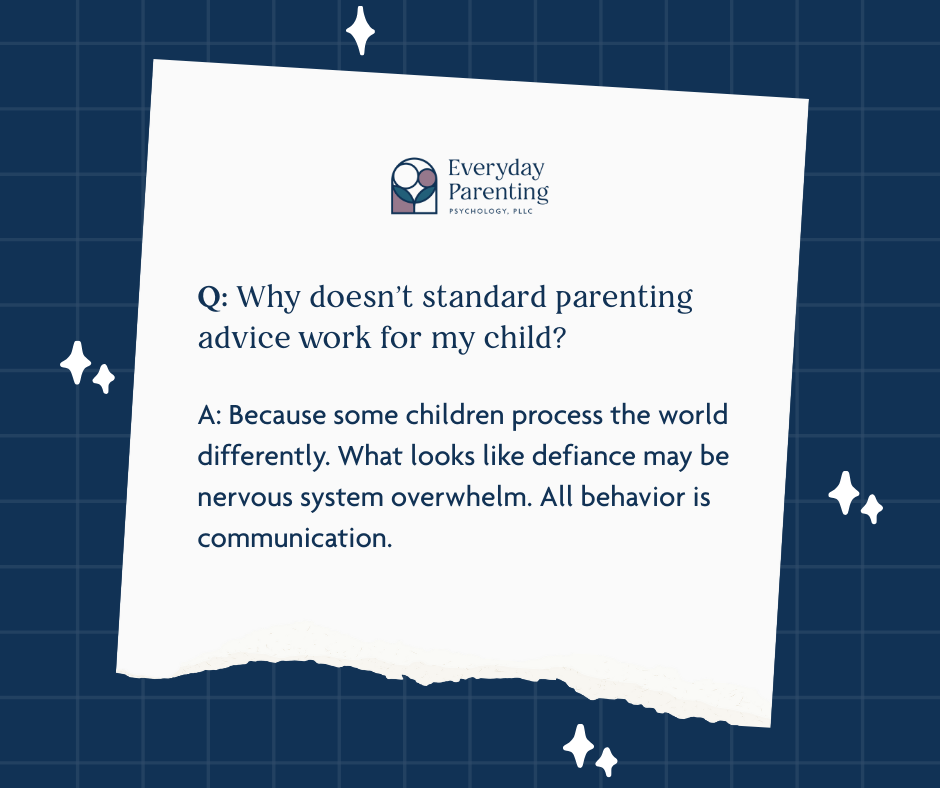
These approaches break down when individual differences make standard strategies ineffective or even counterproductive. A child withADHD may not respond to the same systems that motivate neurotypical peers. A highly sensitive child might become more dysregulated rather than soothed by approaches that work for most children. A child with a trauma history may perceive standard limit-setting as threatening rather than containing. A family managing multiple complex needs simultaneously faces challenges that no single strategy post can address.
The gap between information and application matters here. Knowing that connection before correction works as a principle does not tell you how to apply it with a child whose attachment patterns make connection feel unsafe, or whose nervous system dysregulates so rapidly that finding moments for connection becomes nearly impossible. Understanding developmental stages does not address what to do when your child's development does not follow expected patterns. Basic advice offers frameworks, but implementation requires expertise in adapting those frameworks to specific nervous systems, family dynamics, and contextual realities. We use evidence-based therapeutic approaches grounded in research and adapted to each child.
Understanding the Limitations of Social Media Guidance
The rise of parenting content creators has democratized access to information while simultaneously creating questions about expertise. Many accounts share valuable insights and information, but the platform itself has limitations that affect the guidance it can provide.
Follower count and engagement metrics measure popularity rather than clinical expertise. An account may offer genuinely helpful information, but without professional training, content creators cannot assess whether a child's behavior reflects typical development, neurodivergence, trauma responses, or other factors requiring specialized intervention. They cannot evaluate family systems, recognize contraindications for particular strategies, or adjust recommendations based on treatment response.
The challenge extends beyond what may be good yet ineffective advice. When parents implement strategies correctly and see no improvement or worsening behavior, many conclude they are doing something wrong or that their child is particularly difficult. This can increase parental stress and guilt while delaying access to approaches that would actually help. The child who becomes more dysregulated with standard techniques does not need stricter implementation of those techniques; they need accurate assessment of why their nervous system responds differently and strategies matched to their actual neurobiology.
Social media content also tends toward simplification because nuance does not translate well to short-form content. Complex clinical realities get compressed into digestible tips that may capture general principles while missing critical contextual factors. A post cannot include all the considerations a clinician would assess in real time. It cannot adjust based on family response or identify when a particular approach is contraindicated for a specific child. The medium itself creates inherent constraints on the guidance social media can provide.
This doesn't mean parenting content lacks value. It means recognizing its appropriate scope. Social media can introduce concepts, normalize struggles, and provide general developmental information. It cannot replace clinical assessment, individualized treatment planning, or the ongoing adjustment that effective intervention requires. When families need more than general information, continuing to rely on generic content can delay access to support that would actually address their specific challenges.
What Makes Support Specialized
Specialized support differs from common advice in its foundation, process, and outcomes. Rather than offering strategies assumed to work for most children, specialized providers conduct thorough assessments to understand the specific factors shaping a child's behavior and family's experience, then develop and adjust interventions based on that individual understanding.
Understanding Individual Differences
Effective specialized support begins with recognizing that children differ in ways that fundamentally alter which approaches will help. Neurodivergent children process information, regulate emotion, experience sensation, and navigate social interaction differently than neurotypical peers. These differences are not deficits requiring correction but variations requiring strategies matched to how their nervous systems actually function.
For example, a child withanxiety may need exposure-based approaches, while a child who appears anxious but actually has interoceptive difficulties requires interventions focused on body awareness and sensory processing. These look similar behaviorally but require completely different treatment approaches. Without an accurate understanding of what underlies observable behavior, intervention cannot target actual mechanisms effectively.
Temperament matters enormously. Highly sensitive children require different intensity, pacing, and sensory consideration than less reactive peers. Strong-willed children need approaches that honor their need for autonomy while maintaining necessary structure. Developmental trauma and attachment patterns shape how children interpret relationship dynamics and respond to adult guidance in ways that make standard parenting approaches ineffective or, less commonly, even re-traumatizing without modification.
Medical and sensory factors often go unrecognized in behavioral struggles. A child with chronic pain, sleep disturbance, or undiagnosed sensory processing differences cannot regulate behavior effectively, regardless of parenting approach, until underlying physiological factors are addressed. Specialized providers know to assess these dimensions and coordinate care across disciplines when necessary.
Family System Assessment
Children exist within family systems, and effective intervention requires understanding the full context shaping behavior. Parental mental health, capacity, and their own histories affect the implementation of any strategy. A parent experiencing depression or significant anxiety may struggle to maintain consistency or provide the emotional attunement some approaches require, not because they are inadequate but because their own nervous system needs support.
Sibling dynamics, cultural factors, and practical realities all shape what interventions are realistic and sustainable. An approach requiring extensive one-on-one time may be theoretically ideal but practically difficult to implement in a family with multiple children and busy schedules. Cultural values around discipline, emotional expression, or family hierarchy may conflict with mainstream Western parenting advice in ways that need acknowledgment and integration rather than dismissal.
Specialized providers assess these systemic factors and develop interventions that work within actual family realities rather than idealized conditions. This might mean adapting strategies to work within existing constraints, coordinating with other family members, or addressing parental needs directly as necessary foundation for supporting the child.Parent coaching often focuses substantially on these systemic factors because sustainable change requires working with family reality.
Individualized Strategy Development
Once assessment clarifies what factors are driving behavior and what family resources exist, specialized providers develop strategies tailored to that specific child and system. This does not mean inventing entirely new techniques but rather selecting from evidence-based approaches and adapting them to match how this particular nervous system functions and what this particular family can implement.
For some children, this might mean incorporating sensory regulation strategies throughout the day. For others, it involves teaching self-advocacy skills or addressing social communication difficulties directly. Some families benefit from restructuring environments, others from intensive parent skill-building, and many from combination approaches that address multiple factors simultaneously. What matters is matching intervention to assessment findings.
Specialized support also includes ongoing adjustment based on response. What works initially may need modification as children develop or circumstances change. A provider familiar with your family can track progress, identify when strategies need updating, and modify approaches before problems escalate. This iterative process differs fundamentally from trying strategies from social media posts, seeing no improvement, and moving on to the next recommendation without understanding why the first approach failed.










Professional Training and Accountability
Licensed clinicians operate within ethical guidelines, supervision structures, and professional accountability systems that govern practice. They maintain diagnostic and assessment capabilities, stay current with research literature, and have training in recognizing when presentation suggests factors requiring referral to other specialists. They work within the scope of competence and face consequences for practicing outside ethical boundaries.
This structure protects families. A licensed provider who assesses your child brings years of training in differential diagnosis, child development, evidence-based treatment, and ethical practice. They can distinguish between behaviors that reflect neurodivergence, trauma, typical development, or medical factors because they have extensive training and supervised practice in making these determinations. They can identify when your family's presentation suggests the need for developmental diagnostic assessment, psychiatric consultation, or other specialized evaluation.
Recognizing When You Need Specialized Support
Several indicators suggest your family would benefit from specialized support:
Strategies consistently fail despite what appears to be careful implementation. You have read multiple sources, followed the steps, and given adequate time, yet see no improvement or worsening behavior. This suggests the approach may be mismatched to your child's needs.
Your child's distress increases with standard approaches. Techniques meant to be calming escalate dysregulation. Positive reinforcement systems create more anxiety rather than motivation. Connection attempts trigger withdrawal. When conventional approaches make things harder, assessment of why becomes essential.
Your parental intuition suggests that something about the standard recommendations feels insufficient or wrong for your child, but you cannot articulate what or find alternatives. This intuition often reflects an accurate perception that your child differs from the assumptions underlying guidance. Checking your intuition with a specialized assessment frequently validates those concerns.
Observable behaviors suggest underlying factors beyond typical development. Sensory sensitivities that interfere with daily functioning, emotional intensity that appears out of proportion to the triggers, social difficulties that persist despite support, or developmental patterns that do not align with expected milestones all warrant professional evaluation. Childhood anxiety, ADHD, autism, and other neurodevelopmental differences often present initially as behavioral challenges that standard parenting advice cannot successfully address because underlying neurological factors require specialized intervention.
Family system strain indicates that current approaches are unsustainable. When stress levels become overwhelming, relationships deteriorate, or parental functioning declines significantly, the situation requires more than behavior management strategies. Family therapy or intensive parent support may be necessary to address systemic factors maintaining difficulties.
Finding the Right Specialized Support
Specialized support takes multiple forms depending on needs. Child therapy addresses emotional, behavioral, and developmental difficulties directly with the child. Parent coaching provides comprehensive guidance on strategy implementation and parenting approaches matched to your specific child and family. Diagnostic assessment clarifies underlying factors driving observable behaviors, which then informs treatment planning and other recommendations. Many families benefit from combination approaches addressing multiple factors simultaneously.
When seeking support, ask about the provider's training, experience with your child's specific presentation, and approach to treatment. Inquire whether they use evidence-based practices, how they measure progress, and what family involvement looks like. Clarify whether they can provide any needed diagnostic services or whether a separate assessment would be recommended. Understanding what specialized work actually involves helps set realistic expectations and identifies a good fit.
Expect that effective specialized support requires time to see results. Unlike posts promising immediate improvement, meaningful change in complex situations develops gradually as assessment clarifies factors, interventions target actual mechanisms, and strategies are refined based on response. This does not mean waiting indefinitely without progress but rather understanding that sustainable change develops over time.
The Relief of Accurate Understanding

Many parents describe profound relief when they finally receive an accurate understanding of their child's needs and family dynamics. The shift from "what am I doing wrong" to "this is what my child needs and why standard approaches weren't working" validates their experience while opening access to strategies that actually help. Parental intuition that something was different about their child or situation gets confirmed rather than dismissed.
This understanding also reduces the shame and self-doubt that accumulates when basic advice fails repeatedly. Learning that your child's nervous system functions differently, that family circumstances create legitimate constraints, or that your situation requires specialized expertise removes the burden of assumed parental failure. You were not doing it wrong; you were using approaches designed for different circumstances.
Access to strategies matched to actual needs transforms both child wellbeing and family functioning over time. Children receive support appropriate to their nervous systems. Parents develop approaches that work rather than continuing to implement ineffective strategies due to a lack of alternatives.Developing strong family dynamics becomes possible when interventions target actual factors, and when families receive ongoing support, adjusting approaches as children develop and needs change.
Conclusion
Traditional parenting advice serves an important function for many families, but it cannot address the full range of individual differences and complex dynamics that some families face. When common strategies consistently fail, this does not reflect parenting inadequacy but rather indicates the need for specialized assessment and individualized intervention.
Recognizing these limitations and accessing appropriate support reflects wisdom and care for your child's well-being. Your child deserves strategies matched to how their nervous system actually works. Your family deserves approaches that fit your real circumstances. Trust your intuition when something feels mismatched, and seek the specialized support that can provide what standard advice cannot. When the books and podcasts aren't cutting it, it's not because you're doing it wrong — it's because your child needs a different approach. Our parent coaching starts with understanding your specific child.
At Everyday Parenting, we believe in empowering families to create meaningful connections and navigate challenges with compassion and confidence. Whether you're seeking strategies to address specific behaviors or simply want to strengthen your family bond, we’re here to support you every step of the way. Contact us today to learn how our evidence-based approaches can help your family thrive.
